RF has evolved. Its education has evolved as well.
From the development of radar systems during World War II to today’s electromagnetic simulators, RF engineering has undergone a continuous transformation. Today, the education of an RF engineer requires a combination of electromagnetic fundamentals, practical device design, advanced simulation, and hands-on experience with professional tools.
The MUIRF has been designed precisely to address this evolution.
This vision was articulated by internationally recognized pioneers of modern RF engineering, including Kamal C. Gupta, Tatsuo Itoh, and Arthur A. Oliner, in their paper “Microwave and RF Education: Past, Present and Future,” published in the IEEE Transactions on Microwave Theory and Techniques. In this publication, they anticipated five major challenges in the education of RF and microwave engineers:engineering.
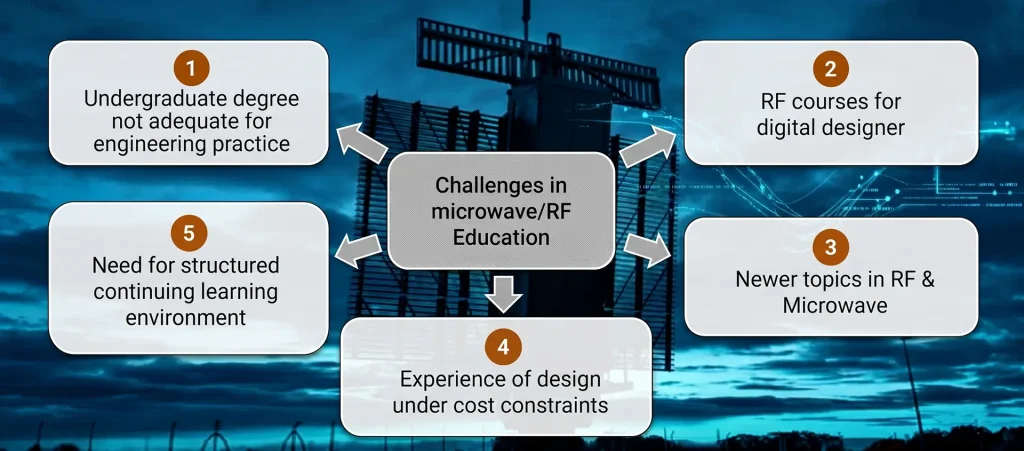
One of the greatest challenges is the growing recognition, both in academia and industry, that an undergraduate degree alone does not adequately prepare students for the practice of RF and microwave engineering.
The MUIRF is designed to address this challenge. That is why it combines a strong theoretical foundation with hands-on training in state-of-the-art laboratory facilities, using the same professional software tools employed throughout the RF and microwave industry.

Escuela Técnica Superior
de Ingeniería de Telecomunicación
Universidad Politécnica de Madrid
The Master’s degree
Career Opportunities
Quick Links

© 2026 ETSIT UPM. All rights reserved.